Showing posts with label LSM2101. Show all posts

Tuesday, 13 September 2011

LSM2101 Part II Lecture 2 Ammonia Production and Detoxification

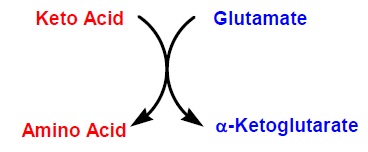
Conversion of AA to Keto Acids
  • Oxidative Deamination
    • L-AA Oxidase + FMN + Catalase
    • L-Glutamate Dehydrogenase + NAD+
  • Transamination
    • Mechanism: 
      • Transfer of amine group from AA to PLP: 1. Transamination 2. Tauromerization 3. Hydrolysis
      • Transfer of amine group from PLP to Keto-Acid: reverse of above
    • General: 
    • Aspartate-Aminotransferase (Glutamate-oxaloacetate transaminase)
    • Alanine-Aminotransferase (Glutamate-pyruvate Transaminase)
    • AST & AST: indication of damaged cells if found in blood serum.
    • Trasndeamination: Transamination + Oxidative Deamination
    • Importance:
      • Funneling to glutamate for conversion to ammonia.
      • Synthesis of non-essential amino acids.
  • Non-Oxidative Deamination
    • Ammonia Lyases
    • Specific Deaminases:
      • Serine dehydratase (L-serine hydrolase)
      • Threonine dehydratase
      • Cysteine desulfhydrase
Excretion of Ammonia
  • AA -> Glu (1 eq NH3) -> Gln (2 eq NH3): happens in everywhere, transported to kidney or liver.
  • Gln (2 eq NH3) -> Glu (1 eq NH3) + NH4+: only happens in kidney and liver.
  • Ion-trapping mechanism: since NH4+ can't cross cell's membrane, ammonium ions in kidney lumen cannot enter kidney cells.

LSM2101 Part II Lecture 3 The Urea Cycle and Disorders

Lecture 3: Urea Cycle / Ornithine Cycle


  • Urea: NH2-CO-NH2 (first N is from Asp, the other one is from ammonia, C is from CO2)
  • Carbamoyl Phosphate synthesis is a rate-limiting step
  •  Regulation:  Carbamoyl Phosphate Synthetase
    • CP I: ammonia dependent, N-acetylglutamate -> activator, mitochondrial
    • CP II: Amide-N of glutamine, independent from  N-ace glu, cytoplasmic
    • N-acetylglutamate: from Glu + Arg using Acetylglutamate Synthase (N-acteyl Transferase)
  • Kreb's Bicycle
  •  Metabolic Disorder - Hyperammonemia (Defects in enzymes)
    • Hyperammonemia Type I: Carbamoyl Phosphate Synthetase I
    • Hyperammonemia Type II: Ornithine Transcarbamoylase
    • Citrullinemia: Argininosuccinate Synthetase
    • Argininosuccinic aciduria/acidemia: Argininosuccinate lyase/Argininosuccinase
    • Argininemia: Arginase
  • Nitrogen Disposal
    • Ureotelic-Urea: Mammals
    • Ammonotelic-Ammonia: Fishes
    • Uricotelic-Ric Acid: Birds

    Friday, 9 September 2011

    LSM2101 Part II Lecture 1 Overview

    So, Part 2 is about Amino Acid Metabolism.
    I skipped the first part since I've rarely attended the lectures. :D But the first part is about carbohydrate metabolism. Maybe I'll post the summary later.


    Okay then...
    Let's go on to the first lecture of second part of LSM2101:  Overview


    1. Why do we need amino acids?
    protein synthesis, energy & gluconeogenic substrates, neurotransmitter, hormones, heme & nucleotide biosynthesis.


    2. Composition of body
    50% dry matter = protein, 1-2% dry matter = free amino acids, no large reservoir of amino acids.


    3. Where does body gets amino acids?
    dietary proteins (exogenous), breakdown of body's proteins (endogenous), biosynthesis.


    4. Dietary Proteins' Fate
    • Intake:
      • minimum daily req = 30 g for 70kg person
    • Digestion:
    • Absorption & Transportation:
    • Inborn Errors: Aminoacidurias
      • Cystinuria: failure to absorp CystineOrnithineArginineLysine -> Cystine Kidney Stones
      • Hartnup's Disease: failure to absorp Trp, Phe, neutral AA -> Cerebellar ataxia (coordination of involuntary movement), Pellagra-like symptoms.
    5. Nitrogen Balance
    • Balance: Intake = Output
    • Positive N Balance: Intake > Output (Growth, Pregnancy, Refeeding)
    • Negative N Balance: Intake < Output (Starvation, Senescence, Metabolic Stress)